
TR 101 290 Monitoring

TR 101 290 monitoring for DVB transport streams

Continuously check every DVB transport stream against the TR 101 290 measurement guidelines — the framework broadcast engineers still call ETR 290. Priority 1, 2, and 3 errors are tracked in real time, with alarm history and reporting, so structural faults are caught before they reach air.

Why TR 101 290 monitoring matters

Priority 1 errors mean off-air

TS sync loss, PAT, PMT, and continuity errors make a service unwatchable. They need an alarm the moment they occur.

Priority 2 warns of drift

PCR timing, CRC, and PTS problems degrade the viewer experience gradually. You want them flagged before they escalate.

Priority 3 keeps you compliant

PSI/SI and EPG repetition rates affect guides, HbbTV, and regulatory reporting. Trends matter as much as instant alarms.

TR 101 290 in one view

Every TR 101 290 check, live, per service and per PID

The Dualz TR 101 290 view maps the full ETR 290 error hierarchy onto your live transport stream. Each Priority 1, 2, and 3 indicator shows current state, an occurrence count, the last event time, and the PID and service involved — so an engineer can move from “something is red” to root cause without switching tools.
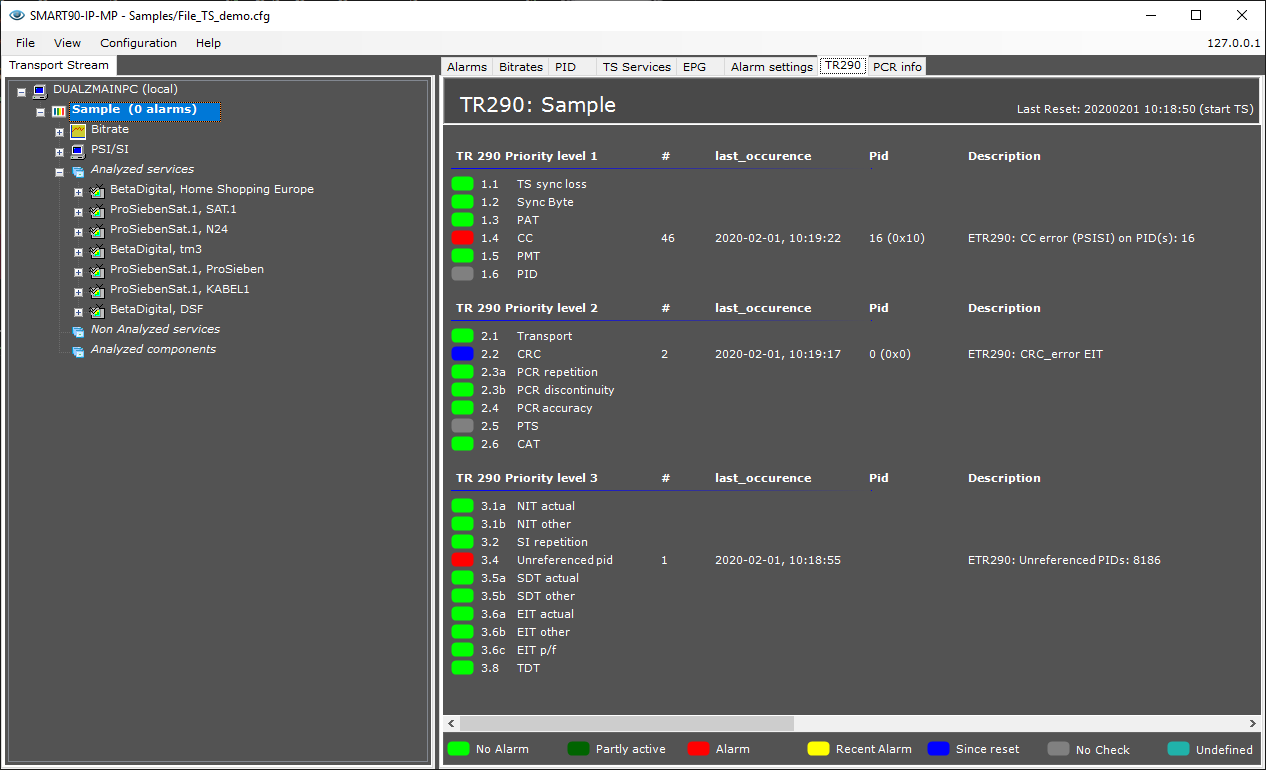
  • Priority 1: TS sync loss, sync byte, PAT, PMT, PID, continuity count
  • Priority 2: transport, CRC, PCR repetition & discontinuity, PCR accuracy, PTS, CAT
  • Priority 3: NIT, SI repetition, unreferenced PID, SDT, EIT, TDT
  • Per-PID and per-service attribution for every error
  • Occurrence counts and last-occurrence timestamps
  • Colour-coded alarm, recent-alarm, and no-check states
Dualz TR 101 290 monitoring dashboard showing Priority 1, 2 and 3 ETR 290 error tables with PID and last-occurrence details for a DVB transport stream
What the levels mean

The three TR 101 290 priority levels, mapped to action

TR 101 290 groups transport stream measurements into three priorities. Dualz monitors all three continuously so your team can alert hard on the critical ones and trend the rest.

Priority 1

The stream is broken

Sync loss, missing PAT or PMT, PID and continuity count errors. These make a service undecodable. Dualz raises an immediate alarm so on-call engineers respond before viewers do.

Priority 2

Something is wrong, watch it

Transport and CRC errors, PCR repetition and discontinuity, PCR accuracy, and PTS faults. Dualz trends these and alerts on rate or persistence, catching a degrading signal early.

Priority 3

Informational & compliance

SI/PSI repetition, NIT, SDT, EIT, and TDT timing. These drive EPG accuracy, HbbTV, and regulatory reporting. Dualz keeps the history you need for compliance evidence.

Included in DVB & Hybrid

TR 101 290 compliance is part of DVB and Hybrid monitoring

TR 101 290 analysis runs in the same workflow as multiviewer, alarm notification, and reporting — so transport compliance, video and audio quality, and PSI/SI health stay aligned in one operational view.

  • Continuous Priority 1, 2, and 3 analysis on every monitored service
  • TR 101 290 alarms in the same view as video, audio, and PSI/SI health
  • Alarm and event history database for post-incident review
  • Exportable reports for compliance evidence and SLA reporting
  • Works across DVB-S/S2, DVB-T/T2, DVB-C, ASI, and TS over IP
  • Managed onboarding so the team focuses on operations, not setup
Tier coverage

Where TR 101 290 applies

DVB Monitoring — full TR 101 290 analysis for satellite, cable, and terrestrial transport streams.

Hybrid Monitoring — the same TR 101 290 compliance across your DVB and IP/OTT operation in one platform.

Faults caught at transport level

Priority 1 conditions raise an immediate alarm, so a broken service is flagged the moment sync, PAT, or PMT fails.

Degradation spotted early

PCR and PTS trends surface a failing encoder or link before it becomes a Priority 1 outage on air.

Compliance you can prove

Alarm history and exportable reports give you TR 101 290 evidence for regulators, carriage agreements, and SLAs.

Need TR 101 290 monitoring in your DVB setup?

Talk to us and we’ll map the ETR 290 error hierarchy into a monitoring setup that fits your operation, including alarm history and compliance reporting.

See TR 101 290 status next to your broadcast alarms

Managed DVB monitoring with continuous TR 101 290 (ETR 290) analysis, alarm history, and reporting that helps you catch transport faults and prove compliance.

Contact us

Give us a bit more information about what you’d like to discuss — we’ll come back to schedule a call.

Stream type
Deployment
Book a call

Find your monitoring solution